Super Guide: Going to France for surfing
France is a country of contrasts and where surfing began in Europe. Throughout the year, the waves fill the coast with winter being the most consistent season, although it is also possible to surf in the summer months as well.
The northern part of France offers a relaxed atmosphere and a varied coastline dependent on the tides. The water is cold and the winters are hard. As you head south, the water warms and the waves become more consistent. The west coast offers the greatest consistency, stretching from Normandy to the Dordogne. The reefs and spots of Brittany and Limousin hide many hidden gems.
It all started when the first surfers came to this beach back in the sixties and discovered those waves of beach they had not seen in California, among these pioneers were Billy Hamilton, Wayne Linch or Nat Young, these showed the rest of the world the secrets Which hid Hossegor in the video ‘Evolution and Waves of Change’, in the seventies surfers started to arrive from Biarrtitz and in the eighties, with the first championships, it began to be a highly respected sport and starting the surfing industry to be located by area.
A surf trip in France is renowned for having the highest quality sandbars in the world, here are the famous peaks of La Graviere and La Nord, a little more separated La Sud and if it was not a few hundred meters to the north Peaks of Seignosse and a little more to the south of Capbreton and the famous La Pistè.
With luck, but above all with knowledge, the sessions can be unforgettable, the surfing that develops here goes from potent and deep bowling tubes in the Graviere reminiscent of Backdoor, waves that give perfect ramps for maneuvers a little more separated from the shore and Bombs on the outer sandbanks of the Nord, those who enter fifteen feet reminiscent of Sunset.
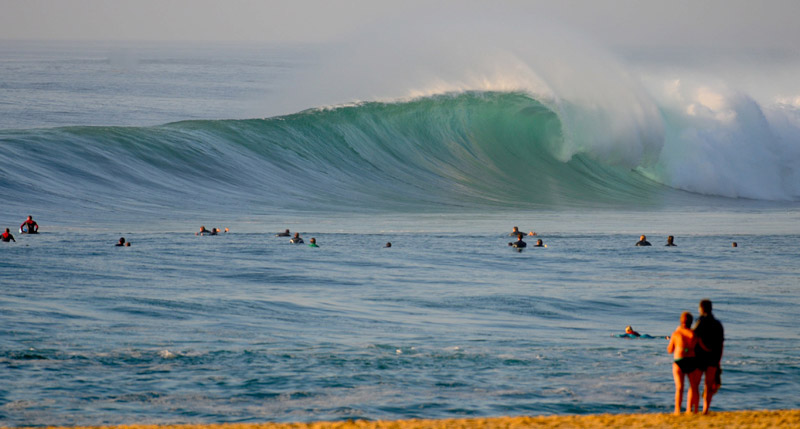
A unique feature in Hossegor is the consistency and extra size of its waves thanks to the submarine canyon that concentrates all the energy of the swell and directs it right towards Hossegor and its main peaks, above all this is evident with the great waves that are surfedas with Tow -in in ‘La Nord’.
The best season for several reasons is from September to November, the sandbanks after the summer are very well formed, the climate is still extremely temperate, even in September it is possible to surf in swimsuit, these are the hottest waters in Atlantic Europe .
To this are added a thousand places of atmosphere to drink, eat and meet people. The accommodation options are varied, hostels, rental apartments that among a group of friends are good option, there are several campsites and payment areas upgraded for vans and camper vans.
At the end of September the Quik pro France is celebrated, the expectation, quality of waves and the charm of the place makes it currently one of the most relevant events of the WCT. Since 2002 the peak of the Graviere is its main venue, recalling the epic conditions that came with the victories of Andy Irons in 2004 or that of Mick Fanning in 2010.
It is logical that in Hossegor he trains and surfs all the elite of European surfing and especially French, among them Jean Sarthou, Miky Picon, Eric Rebiere, Laurent Pujol, Romain Cloiture, Dimitri Ouvre, Patrick Beven, Jeremy Flores, Joan Duru Marc Lacomare , Alizée Arnaud and even the ex-champion of the world and mythical settled here Tom curren and his daughter reads ann Curren. Like the riders, most surf companies also have their European headquarters in Soorts-Hossegor and along with them are renowned shaper creators of the best surf boards, including Christian Bradley, Starks and Peter Daniels.
Content
Conditions for your surfing in France
Hossegor due to the configuration of the coast and the seabed is special with respect to the spots in the surroundings, here there is always a remarkable plus of size and strength.
This is an area that, except for days of extreme and extreme cold in the middle of winter, can be considered a spot for the whole year. It is a spot that even with the west wind onshore, the good placement of the banks makes the waves maintain good surfing and vertical sections, thrust shock and good shape. With light breezes from East and Southeast and in any range of Swell W – NW ideal conditions are usual at sunrise and many times throughout the day.
Spots in France
The spost is a factor that must be taken into account, it can make your session a wonder or break in minutes. This is because the tidal changes in France are very large and can reach 6 meters of difference, this means that throughout the day conditions will change radically and knowledge is the key to surfing is not a ruin , A tip is to look at the premises, they appear and disappear right at the good times.
Too many surfers?
It is important to consider that there is a tendency for people to crowd into the main peaks, but here conditions change quickly and with knowledge there may be perfect waves that appear out of nowhere a few feet away. Another aspect to keep in mind is that important streams are generated, especially near the shore, they are like rivers to be interpreted.

Temperature in France
- In winter the cold is hard. Minimum 5 mm, neoprene scarf and hood. The days of offshore winds with good waves are hard because the air coming from the interior comes frozen.
- In spring the environment is tempered fast although the water is still very cold, and it is good to keep in mind that the sessions can be solitary after the brutal winter storms that change the configuration of the funds.
- In summer the sessions in swimsuit with funny waves between masses is the normal thing and between them occasional rise of the occasional sea. On these dates it is advisable for the traffic not to drive in arrival and departure times to the beach between 10 and 12 in the morning and 5 and 7 in the afternoon.
Spots in Hossegor
The three main peaks of Hossegor Beach are:
La Nord, a peak that when it works is one of the only surfers north of Capbreton when the swell goes up ten feet. This outer bank is a big wave peak where it occasionally becomes Tow-in, it endures enormous rights and has an entrance channel, if you opt for the left make sure you are strong because the paddling is hard and surely the best option is to go out and look The input channel. It can work with all tides but the average is the best. When there is little sea is peak frequented by SUPs.

La Graviere is the typical Hossegor riverbed, it works with all tides but the best is the average and rarely runs at too high tides, with swell of 4 to 8 feet and glassy sea conditions and the beach tubes are perfect.

Sometimes the bottom looks like a messy sea, when that sea approaches the bottom of the Graviere takes shape and the waves are very good although the take-off area is very variable.
La Sud is the peak that is further south looking towards Capbreton, this is a peak that surprisingly despite being faced in the same way as the Nord or Graviere, the size is much lower and unlike in the other lefts Are better, it is frequented by beginners and those who progress, it does not work at high tide and perhaps the quality of the water is regular due to the greater proximity of the river.
Related posts: